|
"LES CABANES" OR "LES SAVOURNINS BAS" – ALIAS "LE VILLAGE DES BORIES" – AT GORDES, VAUCLUSE Christian Lassure A conference with slide show given at the Musée des Arts et Traditions Populaires in Paris in Jean Cuisenier's and Jean-Marie Pesez's classes (1977-1978)
Part 3 The various groups
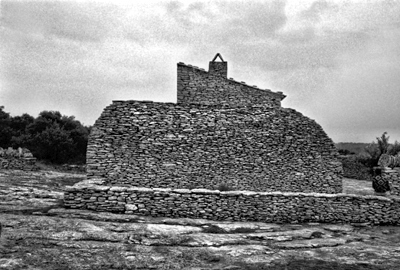
10 - Group I, subgroup Ia: side view of house and cabane
This subgroup is comprised of a conventional first-floor house laid at a right angle with a stable-cum-sheep shelter.
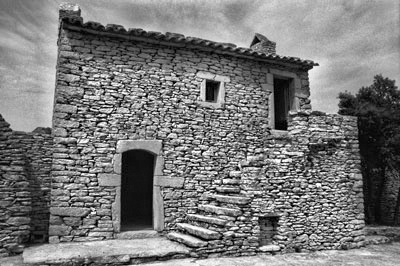
11- Group I, subgroup Ia: the house
This is a rectangular building, with walls of stones bound with clay mortar,
with its façade looking South and its North wall windowless. It has two
floors:
According to Mr Viala, this house may date from the late 17th century or early 18th century. However, according to a collaborator of mine, the lintel above the ground-floor entrance, with its segmental arch, is typical of the second half of the 18th century in Provence.
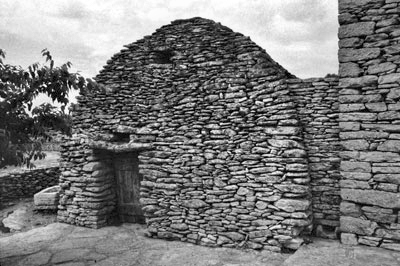
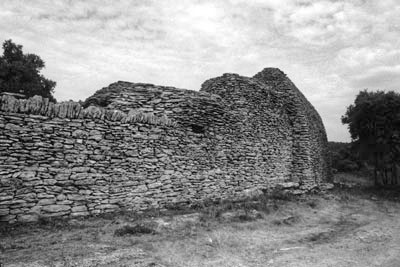
12 - Group I, subgroup Ia: the cabane
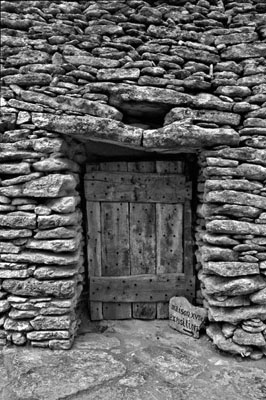
13 - Ditto: the entrance in the gable wall,
14 - Group I, subgroup Ib: view from the South
This subgroup consists of an oven and oven-house, a treading vat and a barn-cum-silkworm house set at an angle of 80°.
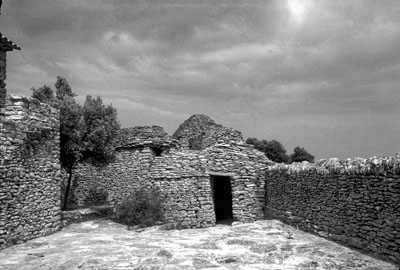
15 - Group I, subgroup Ib: view from the enclosed yard
In the foreground, the oven and oven-house; behind, the treading vat and the barn-cum-silkworm house.
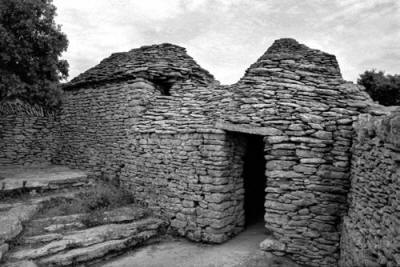
16 - Ditto
The entrance opens into a vestibule which leads past the oven house into the treading vat.
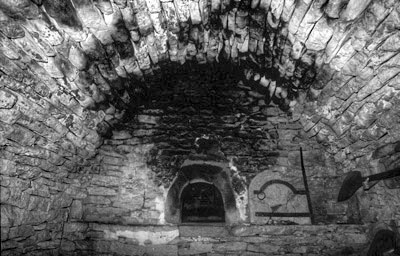
17- Ditto: a view of the inside of the oven house and the mouth of the oven
The ovens and oven houses present on the site do not boast a corbelled vault, they exhibit, instead, a vault of voussoirs, either cupola-shaped with concentric voussoirs (in the ovens) or semi-circular (in the oven houses). For this type of vaulting, wooden centres are needed (which is not the case with a corbelled vault). TO BE CONTINUED © Christian Lassure To be referenced as : Christian Lassure "Les Cabanes" or "Les Savournins Bas" – alias "Le Village des Bories" – at Gordes, Vaucluse, Part 3 http://www.pierreseche.com/projection_gordes_groupe_I_angl.htm February 7th, 2004
Part 1 Part 2 Part 3 Part 4 Part 5 Part 6 Part 7
|