THE VERNACULAR ARCHITECTURE OF BEARN AND BIGORRE IN THE 19TH CENTURY Christian Lassure The former province of Béarn (capital: Pau) corresponds approximately to the eastern two-thirds of the département of the Pyrénées-Atlantiques, while the western third is occupied by the French Basque country. The adjoining département to the East – the Hautes-Pyrénées (capital: Tarbes) – more or less covers the territory of the former province of Bigorre. Between the Pyrenean mountain range to the South and Gascony to the North, Béarn and Bigorre offer a succession of hills and valleys endowed with rich agricultural lands on which cereal farming and cattle raising have prospered. While in the plains villages are the norm, on the plateaux dispersed settlement dominates. In the lower Béarn and Bigorre, the centre of the rural estate was the farmstead with enclosed courtyard, comprising a farmhouse (oustaü), built of stone rubble or pebbles, of rectangular plan and of one or two storeys. Its long-wall façade is sheltered under a steep-pitched ridge roof with two hips (roof pitch: 55°). Facing South, South-East or East as the case may be, the façade is placed perpendicularly to the street and looks onto an enclosed courtyard (parquié). The agricultural dependencies (barn, byre, wine-cellar, hen-house, pigstie) are arranged round the second and third sides of the yard, whereas the fourth side is occupied by a wall in which opens an imposing cart entrance (pourtaü).
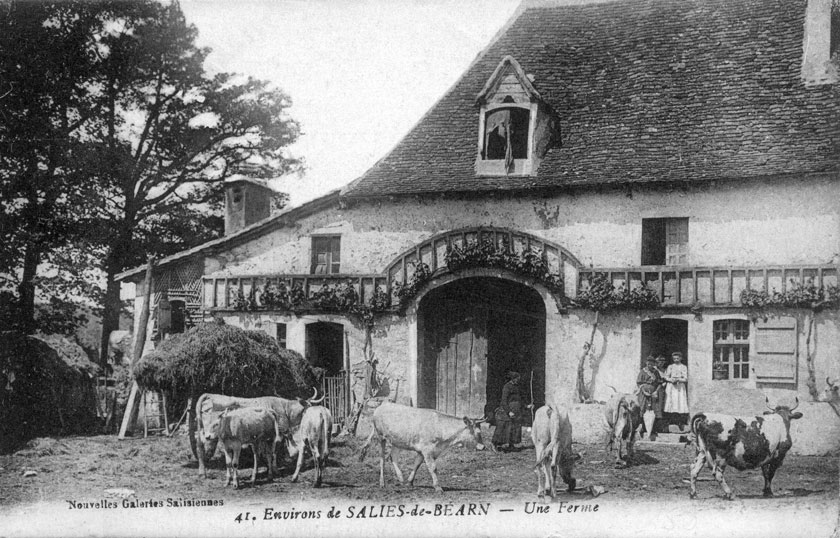
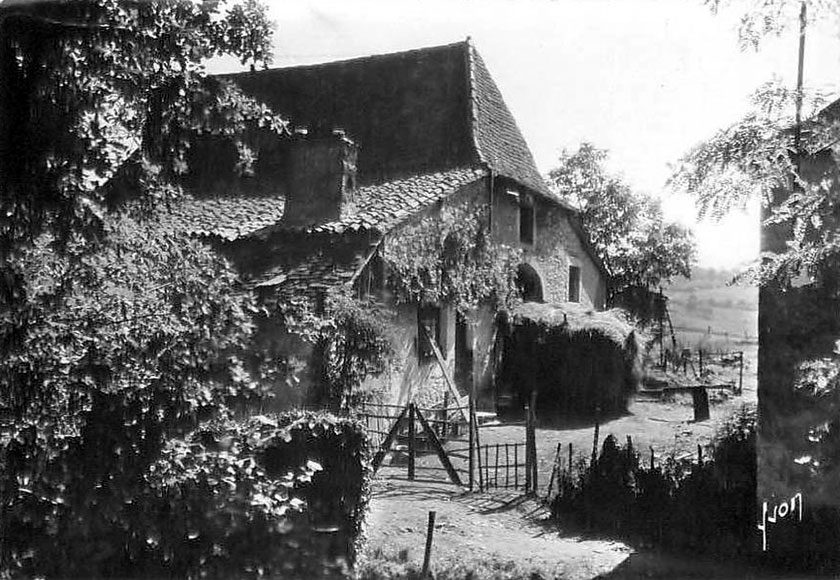
The dwellings in the wealthiest farmsteads follow the bourgeois or urban model of the 18th and 19th centuries: two-storeyed façade with symmetrically-placed openings, central-corridor plan, monumental-looking roof with dormer windows and covering of nibbed flat tiles or slates. This type of house is linked to the growth of the rural economy (notably the spread of maize growing) and the ensuing wealth of the upper strata of the peasant class. At a lower social level, we find a dwelling house which has only a single storey under a granary and follows a different plan, stringing together a common room and a bedroom. This was the dwelling of the smallholder, the sharecropper, the craftsman. Many examples can still be seen in the Tarbes plain and the Baronnies region (Hautes-Pyrénées). The single entrance, set into one of the long walls, opens directly into a common living room or kitchen (cousine), which itself leads into a smaller bedroom (crambe) simply partitioned off by a wooden cross wall. Out of a desire to imitate the bourgeois house, the original plan of some of these “longères” was subsequently altered to a central-entry plan with an axially-placed corridor. The bottom of the social scale was occupied by the single-room house (maysou) of the labourer tied to a large estate. The house-type originating from the urban bourgeoisie and inspired by classic architecture actually superseded, from the 18th century onwards, a former type, also of urban origin but dating from medieval times: the longère” with gable-wall façade, consisting of a kitchen and bedroom laid out in a row at ground-floor level, a granary at upper-floor level behind a half-timbered jettied front, and a steep-pitched ridge roof covered in thatch or wood shingles. A few specimens survive in Béarn, in the Vic Bilh region and at Oloron-Sainte-Marie. Around Orthez and Salies-de-Béarn, the landowning bourgeois families of these cities in the 18th and 19th centuries built for their agricultural tenants farmhouses formed by adding, along both sides of a barn with gable-wall entry, two lean-to aisles, the one to accomodate the sharecropper, the other to accomodate the cows. The outcome is a building with nave and aisles reminiscent of the "métairies" with tripartite plan of neighbouring Aquitaine. The picturesque charm of these edifices is enhanced by the contrast between the high-pitched central roof covered in flat tiles over a granary and the shallow-pitched lateral roofs covered in half-round tiles. In some “métairies” only a single aisle was added to the barn, as a stable was not required.
In the high Pyrenean valleys, where cattle raising on collectively-owned summer pastures was a dominant activity and pastoral activities were run by the valley communities or besiaux, the courtyarded farm tends to disappear while the house-types of lower Béarn and Bigorre have to compete with mountain houses of elongated plan combining under the same roof both living quarters and agricultural quarters. Built of stone, these houses have their openings in one of the long walls, under a steep-pitched ridge roof originally covered in thatch, later to be replaced by slates. On the other hand, buildings with a dual function as byre (for either cows or sheep) and hay-loft - the "bordes" – are strung out at some distance from the villages, in meadows reserved for mowing. These bordes were intended to provide shelter and fodder in winter to herds brought down from the summer pastures. In the mountain valleys of the Aspe, Ossau and Ouzon (Pyrénées-Atlantiques), the mountain house is of the upper-floor hall type: a ground-floor byre is topped by an upper-floor dwelling (estadge) while a hayloft occupies the roof space. Access to the upper floor is reached by an internal staircase opening into the long-wall façade, while the byre has its own separate entrance. A lean-to breadbaking oven, built against one of the gable walls, has its opening set in the fireplace of the common room. The oldest among these houses date back to the 17th century: they have a gable-wall façade and a single doorway at ground-floor level for people, animals and implements alike. The house with upper-floor accommodation is also to be met with in the valleys of Arrens and Estaing and in the Batsuriguère region (south-western Hautes-Pyrénées), mainly in areas of severe climatic conditions. There thatch survived as a roofing material well into the 20th century, along with raised gable ends with stepped coping (pènaus). Relics of thatch coverings and stepped copings can also be seen in the valley of Campan, over temporary barn-cum-byres which, in the 19th century, were made into permanent farmhouses by farmers' younger sons, either by adding a single living room (caouhadé, i.e. heated room) against one of the end walls, or by arranging a dwelling room within the barn-and-byre itself, with only a wooden partition isolating humans from animals. Entry for people was by a door in a gable wall, entry for cows was by a door in a long wall. In the summer pastures of the high mountain valleys of the two provinces, shepherds once erected dry-stone huts (capane) of rectangular plan and with low-pitched two-sided roofs of schist flags or turfs of grass piled on top of purlins and rafters. Set in the middle of dry-stone pens (coueila, cuyala) where sheep were gathered to spend the night, these huts stand today in ruins. BIBLIOGRAPHY BUISAN, Georges, 1989, 'Un type de maison élémentaire en vallée de Campan', in Revue de Comminges, tome 102 (Saint-Gaudens : Société des Etudes du Comminges) CAZAURANG, Jean-Jacques, LOUBERGÉ, Jean, 1978, Maisons béarnaises (I) (Pau: Musée Béarnais) CAZAURANG, Jean-Jacques, 1979, Maisons béarnaises (II) (Pau: Musée Béarnais) LASSURE, Christian, 1981, 'Y a-t-il des "maisons-halle" en Béarn ?', in L'Architecture Vernaculaire, tome 5, p. 65 (Paris: CERAV) LOUBERGÉ, Jean, 1982, Les anciennes maisons rurales des pays de l'Adour (Pau: Imprimerie Moderne) MAGOT, Jean, et al., 1970, Les maisons paysannes de Bigorre, in Maisons Paysannes de France, No 5 (Paris: MPF) PÉRÉ, André, 1979, Les cabanes en pierres sèches des hautes vallées des Nestes (Aure et Louron) (Pyrénées centrales), in L'Architecture Rurale, tome 3, pp. 62-67 (Paris: CERAR) © Christian
Lassure To be referred to as : Christian Lassure |