|
DRY STONE HUTS AND PRIVATE PHOTOGRAPHS
OF THE 1st HALF OF THE TWENTIETH CENTURY
by Christian Lassure
|
|
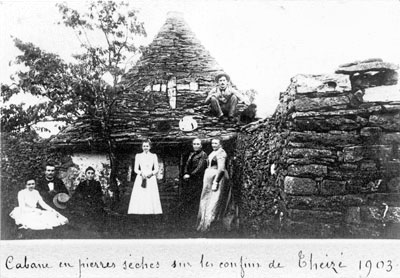
Document N. 1
Sunday outing at Theizé, Rhône, in 1903 An extremely rare document: a private photograph, dated 1903, showing a number of people in their Sunday best on a visit to a winegrower's dry stone hut.
The scene takes place in the territory of Theizé in the Rhône département. The visitors are posing outside a cabane that is still extant today, "the cabane with the cross". On one side of the pavilion-shaped roof, a cross made of embedded white limestone blocks stands out against the background of ochre limestone - the local pierre dorée (golden stone). The menfolk wear boaters, the young ladies are in their white dresses, with an
escort of chaperons. One of the men has perched himself on top of the roof edge, along with his dog.
In those days of limited mobility, small rural edifices such as cabanes, cabanons, maisonnettes deschamps, vide-bouteilles, grangettes, masets, etc., were for many a city dwelling owner a pretext for an outing, or even a weekend retreat.
Credit: Photo published in René Corgé's Constructions en pierre sèche en Beaujolais. Les cabanes de Theizé, in L'architecture vernaculaire, vol 7, 1983, pp. 20-31, notably p. 31. |
|
|
|
|
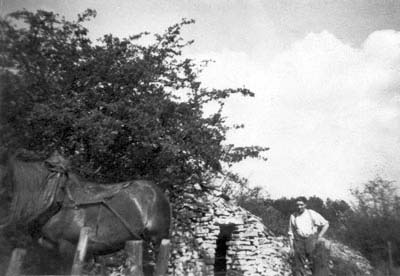
Document N. 2
Burgundian winegrower outside his loge (south of Auxerre, Yonne), in 1936
A private photo belonging to Mr. Jean Guilly and showing his father, a winegrower, posing outside his dry stone loge, south of Auxerre in the Yonne département, in 1936.
A small-sized affair, no more than 5 or 6 metres in inside circumference, the Auxerrois winegrower's lodge barely managed to accomodate his family when they accompanied him to work in the fields. The lodge was fitted with a small niche for the saccot or knife for
pruning vines.
In times of urgent work, the winegrower would spend several several days in his vineyard, sleeping in the lodge. He would go there, too, on a Sunday, in his best clothes, to ascertain the size of the crop and the maturity of the grapes.
Credit: Photo used as a model for the ink-and-pen drawing found in Jean Guilly's Cabanes et mergers d'un vignoble disparu au sud d'Auxerre (Yonne), in L'architecture rurale en pierre sèche, vol. 2, 1978, pages 181-185, more particularly page 185.
|
|
|
|
|
|
|
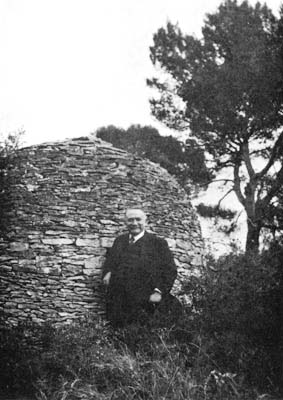
Document N. 3
The President and Miss Capitelle (1923)
This photograph, dated 1923 and showing the back of a dry stone hut, features none other than Gaston Doumergue, who was to be President of the French Republic between 1924 and 1931.
It is worth noting that this great figure, a native of the gardoise region of Vaunage, had developed a passion for the humble dry stone capitelles at a time when these were no longer (or not yet) fashionable. It is no wonder then that he should be seen posing outside one of them, located at Boissières,
his native village. The building is still extant today.
Credit: Photo published in
1/ Aimé Longuet, Les capitelles des garrigues gardoises, in Folklore de France, 30e année, 1979, N. 167-168, pages 11-17, in particular page 14 ;
2/ Claude Bouet, Le système "pierre sèche" : les bocages lithiques des garrigues du bas Languedoc, Pierre Sèche et Patrimoine aubaisien - Ministère de l'Environnement, polycopié, June 1997, 480 p., in particular p. 450 (plus
commentaries pages 397 and 412). |
|
|
|
|
Document N. 4
The novelist, the poet and the sheep shelter (1942)
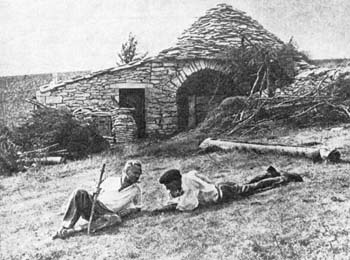
In the foreground of this precious photo taken in 1942 in upper Provence, writer Jean Giono (left) and poet Lucien Jacques (right) are seen conversing cheerfully outside a dry stone sheep shelter.
The building consists of two parts:
- to the right, the sheep shelter proper with a two-sided roof of stone tiles and a front opening topped with an arch of voussoirs ;
- to the left, a lean-to affair, built against the sheep shelter's lower wall and fitted with a pedestrian entrance and a smokestack (the shepherd's lodge).
The hollowed-out tree trunk lying across the slope is just a makeshift trough intended for the sheep.
Considering that, before the 2nd World War, Jean Giono had taken up residence at the farm of Les Graves near Contadour (in what was then the Basses-Alpes département), the scene is most likely set in the Montagne de Lure. As a matter of fact, the sheep shelter in the picture is
the "jas de Bouscarle" at La Rochegiron in the Alpes-de-Haute-Provence départment (an indication kindly supplied by Mr. Bruno Bouscarle on November 4th, 2011).
Credit: Photo of unspecified origin (to date). |
|
|
|
|
|
Document N. 5 :
Cayrou with spiral ramp at Padirac, Lot (late 19th century)
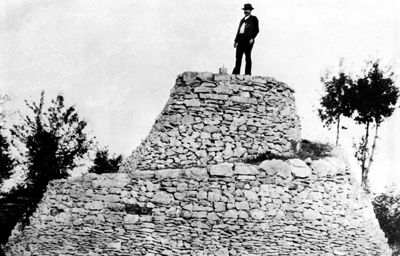
This photo, taken at Padirac, in the Lot département, at the end of the 19th century, is of exceptional interest insofar as it exhibits a built-up stone heap, or cayrou, of outstanding size, that is shaped like a truncated cone and fitted with a
corkscrew ramp.
The edge of the ramp leading to the summit is topped with big, heavy stone blocks intended to prevent the stones of the upper layer of masonry from being dislodged by visitors treading on them.
Credit: Photo belonging to the Société des Etudes du Lot.
|
|
|
|
|
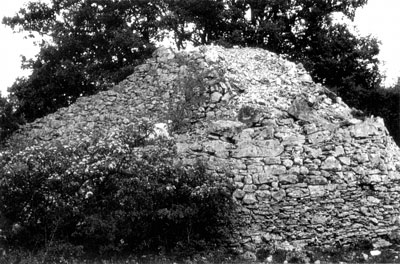
The stone heap is still visible today, though in a state of disrepair. The upper part of the truncated cone has crumbled into a shapeless mass, as shown in a photo published in a local magazine.
By some ironical twist, this vanishng cayrou is described by the author of the article as a "formless heap" "in the process of structuring itself", half way between "the primordial cayrou lacking organization" and "the truly
structured wall".
Credit: Photo published in the July-September 1996 issue of Quercy-Recherche.
|
|
© Christian Lassure
December 24th, 2003 - Updated on July 2nd, 2004 - November 4th, 2011
To be referenced as :
Christian Lassure
Dry stone huts and private photographs of the 1st half of the twentieth centuy
http://www.pierreseche.com/cabanes_et_photos_engl.htm
home page
sommaire photos
french version
|